

The Case for a Chill Home: How Ambient and Balearic Soundscapes Transform Life for All Ages (and Even Pets)

Filling a home with chill music is far more than a stylistic choice or a background soundtrack. It is an act of intentional design, a conscious shaping of the emotional, psychological, and even spiritual environment in which life unfolds. A home saturated in chill, downtempo, and Balearic soundscapes becomes a living ecosystem of calm—a sanctuary where the nervous system can rest, the heart can open, creativity can flourish, and connection across generations (and even species) deepens in unexpected ways.
In a world of relentless stimulation, constant alerts, and unending demands, the concept of “chillout” has become universally understood. Across cultures and languages, people recognize “chillout” as shorthand for stepping out of chaos and into a gentler state of being. The ubiquity of the word reflects something profound: the human spirit is hungry for ease, for softness, for space. Chill music is one of the most elegant, accessible ways to offer that to ourselves and to everyone who enters our homes.
A Home as a Sonic Sanctuary
Every home has a mood. Some homes hum with restless energy, some pulse with urgency, and some feel like a soft exhale as soon as you cross the threshold. When chill music fills a space, room by room, hour after hour, the home ceases to be just a physical structure. It becomes a sanctuary of vibration.
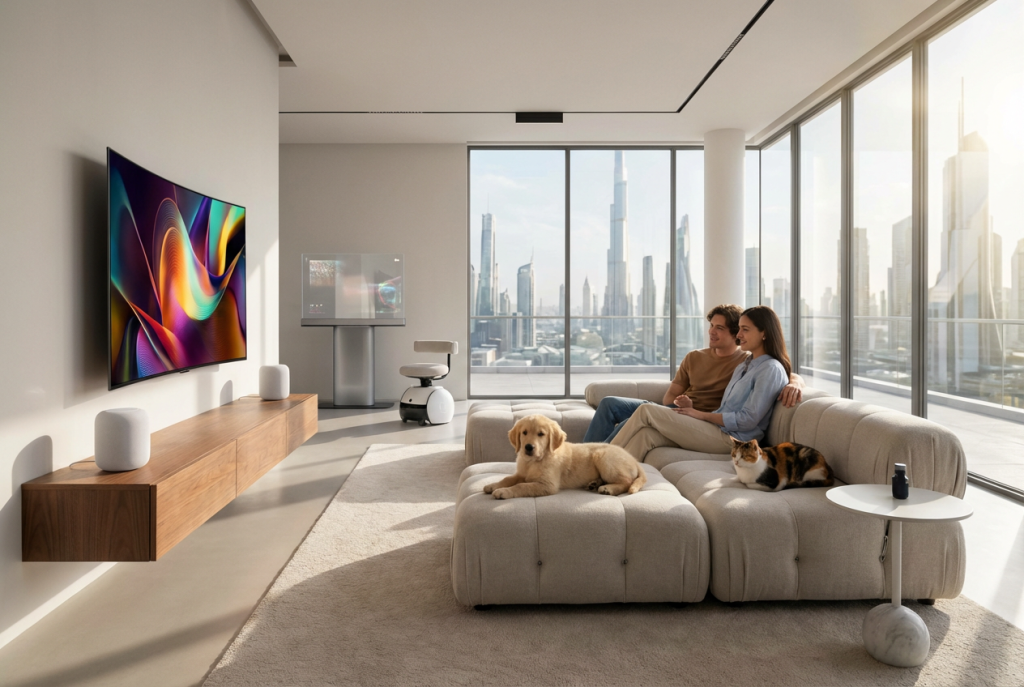
In a setup where multiple speakers—such as a network of HomePods—are linked throughout the house, chill music does not remain confined to a single room. It becomes a kind of audio atmosphere, like air or light. The sound wraps itself around furniture, softens sharp corners, and quietly dissolves the invisible tension that accumulates in modern life. The kitchen, the living room, the bedroom, even the hallway—all become connected by a shared, gentle sonic thread.
This is the opposite of the jarring experience of walking from a loud room into silence or from silence into harsh sound. Instead, there is a seamless continuity—a sonic continuity that mirrors the kind of emotional continuity most people long for: smooth transitions, gentle edges, the absence of sudden shocks.
A chill-filled home communicates something without words: “You are safe here. You can breathe here. You can be yourself here.”
The Emotional Geometry of Chill
Chill music often shares certain characteristics: slower tempos, warm tonal palettes, lush pads, soft percussion, organic instrumentation, reverb-drenched guitars, subtle piano, gentle synths, and understated beats. These elements combine to create an emotional geometry that is fundamentally inclusive rather than aggressive.
Unlike high-intensity genres that demand attention, chill music invites attention. It leaves space between notes and respects silence as part of the composition. This spaciousness offers the psyche room to move, explore, and reflect. Rather than crowding the mind, it opens it.
Over time, this has a cumulative effect. As chill music becomes a consistent presence in the home, emotional reactivity tends to soften. Everyday stressors—traffic, deadlines, minor conflicts—still arise, but they do so within a softened field. The background mood of the house is not agitation, but ease. This doesn’t magically erase difficulty, but it changes the context in which difficulty is experienced. The emotional “floor” rises; the baseline becomes calmer.
A Cross-Generational Language of Calm
 One of the most compelling reasons to fill a home with chill music is its remarkable ability to resonate across ages. Very young children, teenagers, adults in midlife, and older adults often respond positively to chill soundscapes, even when their tastes in active listening differ wildly.
Children, especially, are naturally sensitive to mood and tone. They may not have the vocabulary to explain that a certain sound makes them feel relaxed, safe, or curious, but their bodies and behaviors reveal it. In an environment where chill music flows:
– Children often play more quietly and creatively, lost in their own imaginative worlds.
– They may linger more in shared spaces, drawn by the softness rather than expelled by loudness.
– Transitions—like winding down at the end of the day—tend to become smoother when the sonic environment is already supporting relaxation.
Teenagers, who might actively choose different genres when wearing headphones, are often surprisingly receptive to chill music as a household background. It does not compete with their identities or challenge their preferences; instead, it forms a neutral, welcoming canvas. They can sit, scroll, chat, or daydream in a space that doesn’t assault their senses yet quietly invites presence.
Older adults frequently find chill appealing because it avoids extremes. It is neither intrusive nor saccharine, neither hyperactive nor anesthetizing. It feels like a natural companion to reflection, conversation, reading, or simply sitting with a cup of coffee and watching the light change as the day passes.
What makes chill so universally acceptable is that it behaves more like a climate than a performance. It doesn’t insist. It gently accompanies.
Even the Animals Chill Out
 Anyone who has lived with dogs or cats and filled their home with chill music has likely observed something quietly remarkable: animals relax with it. They stretch out, nap, and breathe in rhythm with the softness of the sound.
Pets are exquisitely attuned to vibrational shifts—both emotional and acoustic. They sense tension, sharpness, fear, and agitation long before humans give them language. In a house that is filled with aggressive noise, raised voices, or sudden bursts of harsh sound, animals often appear restless, alert, or on edge.
By contrast, in a home where chill music is the dominant sonic backdrop:
– Dogs often settle near their humans, resting more deeply, with softer body posture and slower breathing.
– Cats, lovers of comfort and subtlety, seem to melt into furniture, following the natural drift of the ambient sound as though it were a stream running through the house.
This is not sentimentality; it is resonance. Chill music functions like an energetic signal to the nervous system—human or animal—that says: “No threat here. You can let go.”
When the entire household, across species, is relaxed, the quality of daily life shifts. Interactions are less frantic. Movement is less sharp. The home feels like a safe, shared nest where everyone is allowed to soften.
The Universality of “Chill Music”
There is a reason people everywhere understand the phrase “Chillout.” It has become more than a genre label; it is a global shorthand for a mood that people crave.
“Chillout” suggests:
– Stepping out of time pressure and into timelessness.
– Moving away from conflict and toward acceptance.
– Trading adrenaline for ease, noise for nuance, performance for presence.
The fact that “Chillout” is recognized and used so widely speaks to a collective recognition: the human nervous system is overtaxed, and the soul longs for refuge. A chill home answers that longing in a simple, elegant way.
This recognition cuts across culture, profession, and lifestyle. From busy parents to solitary creatives, from tech workers to retirees, there is a fundamental common ground: the desire to feel less strained and more connected to oneself and others. A house filled with chill music becomes a living embodiment of that desire, made real in sound.
A Daily Antidote to Overstimulation
Modern life is fast. Screens flicker, feeds refresh, notifications ping, and news cycles churn endlessly. The average person is exposed to more information and more noise in a single day than previous generations encountered in weeks or months.
In this context, a quiet home is not enough. Silence is valuable, but silence exists alongside internal chatter, unprocessed stress, and the residual static of the outer world. Chill music doesn’t erase these, but it does give them a different container.
Consider the difference between walking into a silent house after a long day and walking into a home where a gentle Balearic groove or ambient soundscape is already flowing:
– In silence, the mind may simply amplify its inner noise.
– In a chill-filled home, the external sound is soft but intentional—it offers an alternative pattern for the nervous system to follow.
Slow tempos encourage slower breathing. Recurring motifs and repetitive textures invite the mind into a more meditative state. Subtle tonal shifts offer emotional color without overwhelming the listener. Over time, this daily practice of entering and dwelling within a chill environment functions like a repeated, quiet meditation.
The result is not escapism, but recalibration. A person who spends their evenings in such an environment often wakes with a different emotional baseline: clearer, less brittle, more capable of navigating complexity without collapsing under it.
Background, Yet Deeply Present
One of the paradoxical strengths of chill music is that it can be both deeply present and almost invisible. It does not demand that anyone “listen closely,” yet it rewards attention generously when it is given.
For guests, this is especially powerful. Someone who enters a chill home may not immediately notice the specific track playing, but they will feel something:
– Conversation flows more easily.
– People tend to speak more softly, matching the soundscape.
– Social anxiety tends to lower in an environment that signals safety and ease.
As hosts, people who fill their homes with chill music are quietly curating not only their own emotional experience, but also that of everyone who visits. The music becomes an unspoken gesture of hospitality: “You are welcome to lay down your burdens here, even for a little while.”
The beauty of this approach is that it is inclusive. People don’t have to share the same musical tastes to appreciate the environment. Chill music’s role as atmosphere rather than assertion allows individuals to maintain their identities while still participating in a shared field of calm.
Inspiring Creativity and Deep Focus
 A chill-filled home does not only support rest; it also supports flow.
For those who write, compose music, design, code, paint, or pursue any creative or contemplative path, the surrounding environment is crucial. Overly stimulating sound can fragment attention, whereas a well-curated chill soundscape supports deep focus and sustained engagement.
Chill music, especially Balearic or ambient styles, offers structure without intrusion: gentle rhythms, rolling bass lines, evolving textures, and slow-moving harmonies that give the mind something to ride without forcing it to track every moment. This is ideal for:
– Writing sessions where ideas need space to emerge.
– Music production where inspiration is subtly primed by the harmonic and rhythmic language floating through the home.
– Planning or problem-solving where stress needs to be kept at bay while clarity is cultivated.
In such an environment, creativity feels less like effort and more like a natural response to the conditions at hand. The home becomes a studio, a laboratory, and a temple all at once—a place where ideas are born in the same field of peace where rest and connection also live.
Emotional Regulation Across the Day
Filling a home with chill music is not just about playing nice sounds. When done intentionally, it becomes a kind of emotional architecture, offering different shades of calm across the natural arc of a day.
Morning chill might lean toward gentle, uplifting tones—soft pianos, light guitar, warm pads that invite a graceful entry into wakefulness. Midday chill could introduce slightly more rhythmic elements, supporting focus, movement, and productivity without pushing the nervous system into overdrive. Evening chill often turns toward deeper, slower, more spacious soundscapes that help the body and mind descend toward sleep.
This progression trains not just preference, but regulation. The household learns, collectively and unconsciously, that sound is part of the rhythm of life. The music becomes a subtle but powerful guide for energy:
– Time to rise and orient.
– Time to concentrate and create.
– Time to soften, reconnect, and rest.
Over months and years, this patterning becomes internalized. People who grow up or live long-term in such an environment often develop a more refined sense of their own inner tempo. They can feel when they are rushing unnecessarily or when they are stuck in stagnation—and they intuitively reach for the right sound to help shift their state.
A Gentle Rebellion Against Harshness
Filling the home with chill music is, in many ways, a quiet rebellion against the harshness of the outer world. It is a refusal to allow the loudest, most frantic elements of the culture to dictate the emotional norm inside the most intimate space of life.
This rebellion is not angry. It is not about pushing away the world. Instead, it is about choosing a different center of gravity. From this center:
– The world’s chaos remains visible but does not dominate.
– One’s sense of hope and possibility is protected and nourished.
– The heart stays open more often, because it is not constantly bracing for impact.
Chill music supports this stance effortlessly. It does not shout political slogans or trumpet ideology, yet it embodies a worldview: that softness is strength, that slowness can be wise, that rest is not laziness but medicine.
In a home that lives and breathes this worldview through sound, people tend to move through the world with more empathy. They have rehearsed, day after day, an inner posture of calm and receptivity. They know what it feels like to be unarmored yet safe. That memory travels with them beyond the front door.
Why “Chillout” Belongs at the Heart of the Home
 There is a reason that, when people are overwhelmed, stressed, or overstimulated, the instinctive phrase arises: “I need to chill out.” It is a universal plea for a shift in frequency—from sharp to soft, from contracted to expanded, from effortful to effortless.
Bringing chill music into the home, not as a once-in-a-while playlist but as a living, continuous presence, is a way of honoring that plea in a tangible, daily way. It acknowledges the truth that human beings, of all ages, function better when their environment supports regulation, reflection, connection, and rest.
Children sense it. Teenagers secretly appreciate it. Adults rely on it. Older adults recognize it as a welcome return to something they have long known. Dogs and cats respond with their bodies, stretching out and closing their eyes as the music quietly assures them that all is well—at least within these walls, in this moment.
In the end, filling a home with chill music is not just about taste. It is about philosophy. It is a declaration that the home is not merely a storage space for belongings or a waypoint between obligations. It is a sacred, living field where hearts are shaped, minds are soothed, relationships are nurtured, and beings of all ages and species are invited to rest in the simple, profound state that the whole world understands by a single word:
Chillout.




Be the first to comment